( Matthew 5:1 ) “Seeing the crowds, (Jesus) went up on the mountain, and when he sat down, his disciples came to him.
And he opened his mouth and taught them, saying:
“Blessed are the poor in spirit, for theirs is the kingdom of heaven.”
“Blessed are those who mourn, for they shall be comforted.”
Journeying through the whole of scripture, from Genesis through Revelation, I am convinced that “Good news of THE KINGDOM OF THE HEAVENS” is the prevailing theme; the persistent heartbeat and unwavering desire of the LORD God to personally DWELL with us, his people, as God and King.
Revelation 21:3 succinctly articulates this horizon:
“And I heard a loud voice from the throne saying, “Behold, the dwelling place of God is with mankind. He will dwell with them, and they will be his people, and God himself will be with them as their God.”
In this light, Dallas Willard described the Gospel of the in-breaking Kingdom that Jesus himself preaches as, “the present availability of the with-God life”. As we follow this thread, the question emerges: what is this Kingdom LIKE? What does it mean for us to enter into this life of the Kingdom of the Heavens, here and now, and forever? What is the culture, character, the social and personal implications of a “with-God life”? In the hopes of journeying our way into an answer to these questions, this year I will take a deep dive into Jesus’ body of teaching on the Kingdom that we find in Matthew 5-7; the Sermon on the Mount.
Dallas Willard describes Jesus’ most common method of teaching - particularly with regards to the Kingdom of the Heavens - as “challenging the prevailing assumptions” of his listeners. (“You have heard it said… But I say to you…”) He consistently turns the value system of the world - and its vision of “the good life” - on its head, and invites us to REPENT (change our mind), and begin living according to the entirely different version of reality that he is confronting us with.
And so it is with the Beatitudes: Jesus begins the Sermon on the Mount, declaring as “blessed”, a whole list of people whom common sense logic declare, objectively, to NOT be blessed; possibly even UN-blessable.
“Blessed are the impoverished” (spiritually, or otherwise)
“Blessing are the grieving, and brokenhearted”
“Blessed are the shy, the socially invisible and run-over”…
Because we are all inveterate moralists at heart, we tend to go to great lengths trying to interpret these categories/situations of people in a positive light on their own terms; to make them inherently commendable (ie. “poor in spirit” = “humble”), and make new religious guidelines of them. But to do so misses the whole point.
In the Beatitudes the blessing isn’t the CONDITION. The blessing is the KINGDOM.
The Kingdom of the Heavens, which is now at hand and available to you in Jesus, no matter HOW you stack up according to the value systems and power structures of the world. It’s in this light that Jesus can say, “Blessed are those who MOURN - “when you feel you’ve lost what is most dear to you” (MSG) - the brokenhearted, grieving, and tearful - for they shall be comforted.”
Because the Kingdom of the Heavens is at hand, there is comfort for grief.
Thanks be to God.
There is comfort, because in Christ and his Kingdom, we know that we do not grieve ALONE, and we will not grieve FOREVER.
—
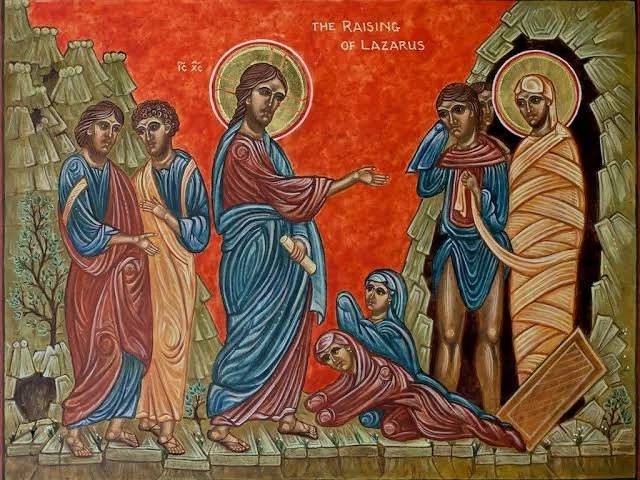
In John chapter 11, we find the story of the death of Lazarus.
Jesus is traveling around teaching, ministering, healing the sick and freeing the spiritually oppressed when word is sent to him that this man - Lazarus - has fallen dangerously ill. Lazarus was the brother of Mary and Martha, who by all accounts were some of Jesus’ closest personal friends. In fact, the message that Mary and Martha send along to Jesus was simply, “Lord, he whom you love is ill.” A couple of verses later, John again reiterates the point. He tells us that “Jesus loved Martha and her sister and Lazarus.” There were a lot of people around Jesus most of the time, but it’s made plain that these folks were not just a few more faces in the crowd.
For reasons that are not immediately clear to us, though, Jesus does not rush to Lazarus. In fact, we are told that after receiving that urgent message, he stayed where he was for two more days. And, by the time he and his disciples finally do begin to make their way towards Bethany, Lazarus has already died. Why did he stay away? Why did he not come sooner? These are questions that we’ll have to seek the answers for in time. But whatever the case may be, as Jesus arrives in Bethany we know that he’s no longer headed to the hospital to visit a sick man; he’s headed to the cemetery to mourn a dead man. And, whatever the circumstances and questions swirling around the timing of Jesus’ arrival, we cannot miss the significance of this: Jesus DOES mourn.
“Now when Mary came to where Jesus was and saw him, she fell at his feet, saying to him, “Lord, if you had been here, my brother would not have died.” When Jesus saw her weeping, and the Jews who had come with her also weeping, he was deeply moved in his spirit and greatly troubled. And he said, “Where have you laid him?” They said to him, “Lord, come and see.” Jesus wept. So the Jews said, “See how he loved him!” But some of them said, “Could not he who opened the eyes of the blind man also have kept this man from dying?” - (John 11:32-37 ESV)
Jesus wept.
As Jesus weeps with and for his loved ones, we witness the tears of God. We see the sovereign one - for whom life, death, and the very cosmos spins around in the palm of his hand - crumpling to his knees, tears streaming down his face, mourning. Sharing in the suffering of his people to the point that he is overcome. The lower jaw of God himself begins to clench and quiver, his eyes glass over with tears, and he loses it in front of all these people. “See how he loved him!” they say.
What do we do with a God who weeps; not in powerlessness, but for love?
Paradoxically and profoundly, it is in the discomfort of Jesus that we find hope for our own comfort restored. Because, as we see in Jesus the heart of a creator God who, compelled by love, enters into and inhabits the journey of suffering and loss and mourning alongside of us, we come to understand that no matter where we are, no matter what we have lost and how broken that loss has left us, we have never been left to mourn alone. The willing, real grief of God becomes makes a way unto our healing… Which is, of course, the Gospel.
“Blessed are those who mourn”. Because, in the loving tears of Christ, we come to know that we do not mourn alone.
—
It is incredible, and totally unheard of - even blasphemous - to consider under almost any other worldview or system of religious thought, but the God we meet in Jesus is a God who suffers with us, and shares our tears. Isaiah refers to Jesus as a “Man of sorrows, acquainted with grief”; “Surely he has borne our griefs and carried our sorrows… upon him was the chastisement that brought us peace, and with his wounds we are healed.”
So Jesus suffers and he mourns, but that is only half the equation. And as profound as it truly is, on its own that is not enough. The tears of Jesus are not enough to make hope possible. Because if Jesus is only a co-sufferer; if all he has to offer are his tears, then he is little more than just a really good friend. But Jesus is more than that; oh so infinitely more! Yes, Jesus has tears. But it turns out that the tears of God are profoundly different from our tears. They are tears of love, not powerlessness.
Our mourning - human mourning - is an expression of the sadness and heartache that comes from being in a place of powerlessness and loss. We mourn, because we have lost someone or something that we have absolutely no power to bring back, so our tears are tears of emptiness and frustration and injustice. Human mourning is a sadness that has no place to go for consolation - with no escape from the emptiness - so we end up depressed, or destructively angry. Eventually our hearts get tired, and we resign ourselves to the fact that there’s nothing that can be done. And so, we then do our best to carry on, trusting that the passage of time will dull the pain.
One of my new favorite recording artists, describing the grief of losing his father, puts it this way:
“So hang onto the hurting
And let it grab a hold
Yeah, the only thing’s for certain
Is it’s out of my control
And, grief is only love that’s got no place to go.”
-Stephen Wilson Jr.
These are our tears: Love, with no recourse for loss. Powerlessness, in the face of pain. But the tears of Jesus are not tears of powerlessness. In fact, they are quite the opposite. When Jesus hears that Lazarus has fallen ill, scripture says that Jesus tells his disciples: ”This illness does not lead to (end in) death. It is for the glory of God, so that the Son of God may be glorified through it.”
Of course, Jesus then proceeds to stay where he is, Lazarus succumbs to his sickness and dies, and then Jesus and his disciples finally arrive in Bethany in the midst of this community’s time of mourning. As we have discussed already, the heart of Jesus is “deeply moved” by this scene; he is troubled, and he mourns. But, our English translations of the originally Greek New Testament can be a little misleading here. Because where our bibles tell us that Jesus was “deeply moved”, the word being translated is “embrimaomai”. The emotional thrust of this term is more akin to prophetic anger; righteous indignation. (Literally: “Snorting of horses” - An image of nostril-flaring offense)
Jesus sees the pain of these people whom he loves, he comes face to face with the evil of death and loss that has thrust itself upon the very-good creation of God and laid waste to these persons, created in love and reflecting the image of God himself. And, what is his response? Jesus doesn’t just get weepy… He gets heart-rendingly pissed off.
This Jesus, who proclaims that he himself is the resurrection and the life that humanity’s hopes hang upon, with tears still in his eyes, walks up to death itself and just throws down. Jesus steps up to the grave of his friend and declares the authority to overturn death and loss. “Lazarus!” Jesus speaks into the darkness of the grave; “Come out.” And Lazarus gets up, and walks out of his own grave.
Do you think the tone of that party changed a bit?
What we realize is that even though you and I may be powerless to stand up to death, powerless to restore those things that have been lost and left us broken and a little less whole, Jesus is not. He is the one who declares victory over death and brokenness, and he is the one who will restore all things to rights. As dramatic as the whole Lazarus episode may have been, this was only a picture and preview of what Jesus will one day work over all of creation itself; made possible by the price paid, and the victory secured, through his own death and resurrection.
“Then I saw a new heaven and a new earth, for the first heaven and the first earth had passed away, and the sea was no more. And I saw the holy city, new Jerusalem, coming down out of heaven from God, prepared as a bride adorned for her husband. And I heard a loud voice from the throne saying, “Behold, the dwelling place of God is with man. He will dwell with them, and they will be his people, and God himself will be with them as their God. He will wipe away every tear from their eyes, and death shall be no more, neither shall there be mourning, nor crying, nor pain anymore, for the former things have passed away…. And he who was seated on the throne said, “Behold, I am making all things new.” (Revelation 21:1-5)
“Blessed are those who mourn, for they will be comforted.”, Jesus says.
The Apostle Paul later reflects, “(we do) not grieve as others do, who have no hope” (1 Thessalonians 4:13)
Rather, in light of the victory of Jesus, we believe and can cling to the knowledge that in the end even the most unspeakable losses will be completely overcome and undone. It isn’t just that in light of heaven we will somehow forget the pain and losses of this present life, but even that the victory of Jesus goes backwards as well as forwards. Jesus does not only redeem our future. One day, in his glory and utter victory, he will redeem and restore our past, too. And, that is why Jesus can say “Blessed are those who mourn.”; because he knows that when Heaven crashes into Earth, the deeper our wounds have gone, the more deeply his healing grace will go… “They will be comforted.”
C.S. Lewis put it this way: that “Heaven, once attained, will work backwards and turn even agony into glory”. In the Lord of the Rings, JRR Tolkien envisions a time in which “everything sad is going to come untrue.” (Keller, ‘Pain and Suffering’ p.118)
One of our great Advent hymns captures it well:
Come, you disconsolate, where’er you languish;
come to the mercy seat, fervently kneel.
Here bring your wounded hearts, here tell your anguish;
earth has no sorrows that heaven cannot heal.
Joy of the desolate, light of the straying,
hope of the penitent, fadeless and pure!
Here speaks the Comforter, in mercy saying,
“Earth has no sorrows that heaven cannot cure.”
Here see the bread of life; see waters flowing
forth from the throne of God, pure from above.
Come to the feast prepared; come, ever knowing
earth has no sorrows but heaven can remove.
Amen.