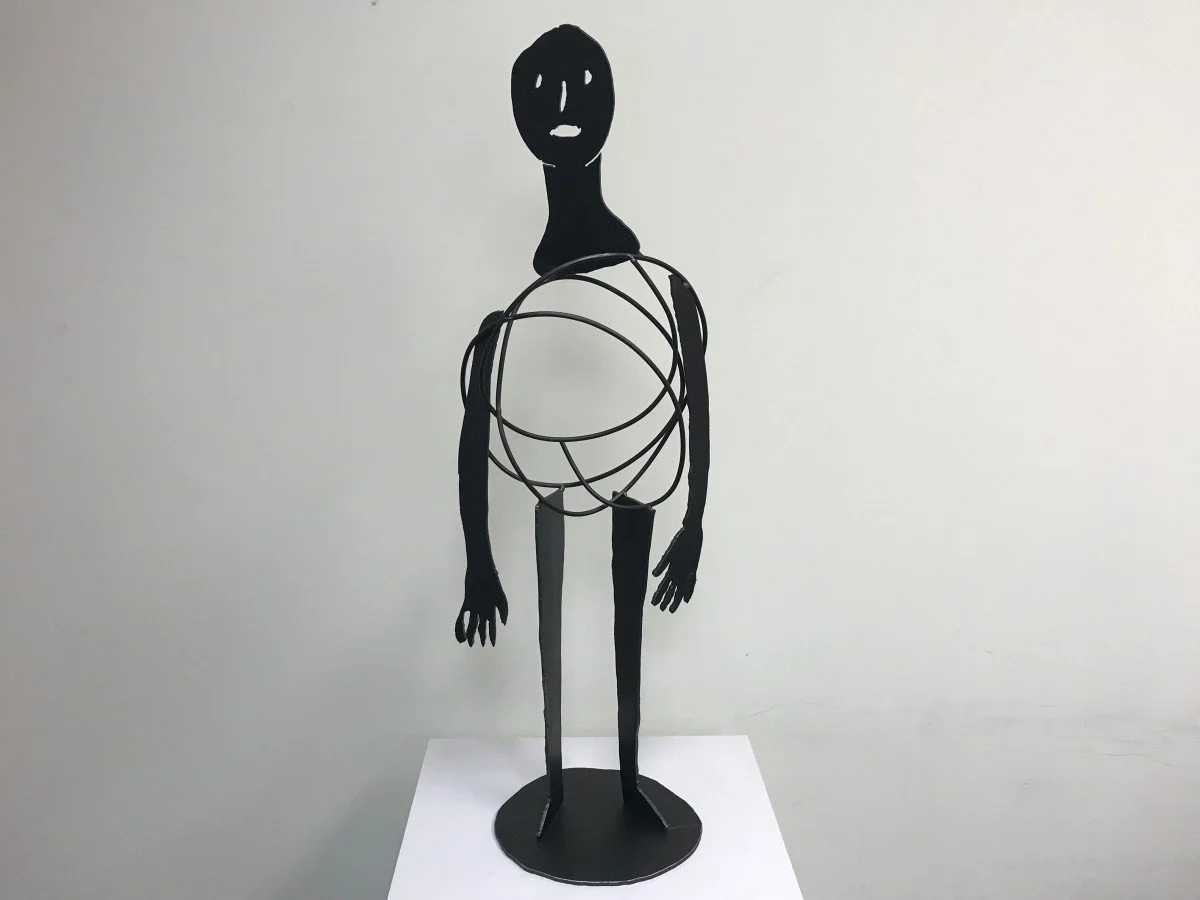
盧淳天 NO Sooncheon, “Empty Man” 空洞的人
( Matthew 4:23 ) “And (Jesus) went throughout all Galilee, teaching in their synagogues and proclaiming the gospel of the kingdom and healing every disease and every affliction among the people. So his fame spread throughout all Syria, and they brought him all the sick, those afflicted with various diseases and pains, those oppressed by demons, those having seizures, and paralytics, and he healed them. And great crowds followed him from Galilee and the Decapolis, and from Jerusalem and Judea, and from beyond the Jordan.
Seeing the crowds, he went up on the mountain, and when he sat down, his disciples came to him.
And he opened his mouth and taught them, saying:
“Blessed are the poor in spirit, for theirs is the kingdom of heaven.”
Or:
“Blessed are the spiritual zeros - the spiritually bankrupt, deprived and deficient, the spiritual beggars, those without a wisp of “religion” - when the Kingdom of God comes upon them” ( D. Willard )
———-
Journeying through the whole of scripture, from Genesis through Revelation, I am convinced that “Good news of THE KINGDOM OF THE HEAVENS” is the prevailing theme; the persistent heartbeat and unwavering desire of the LORD God to personally DWELL with us, his people, as God and King.
Revelation 21:3 succinctly articulates this horizon:
“And I heard a loud voice from the throne saying, “Behold, the dwelling place of God is with mankind. He will dwell with them, and they will be his people, and God himself will be with them as their God.”
In this light, Dallas Willard described the Gospel of the in-breaking Kingdom that Jesus himself preaches as, “the present availability of the with-God life”. As we follow this thread, the question emerges: what is this Kingdom LIKE? What does it mean for us to enter into this life of the Kingdom of the Heavens, here and now, and forever? What is the culture, character, the social and personal implications of a “with-God life”? In the hopes of journeying our way into an answer to these questions, this year I will take a deep dive into Jesus’ body of teaching on the Kingdom that we find in Matthew 5-7; the Sermon on the Mount.
———
Considering the announcements of the Kingdom that we find in the words of Mary (Luke 1:46-55), and John the Baptist (Luke 3:2-6), and in the first public words of Jesus himself (Luke 4:16-19), we can conclude that, whatever this Kingdom is going to be, it will be unexpected, surprising, and will not operate according to the terms of any earthly kingdom that we are familiar with. The Kingdom of the Heavens is the advent of a whole new manner of world, a new way of being alive. As such, it also means the end of that way of life - according to the flesh, the world, etc. - that we had known, beforehand.
In Matthew 4, the movement is starting to pick up steam. Jesus has gotten to work: calling his first disciples, proclaiming the arrival of this new Kingdom, and substantiating that claim with demonstrations of power (“healing every disease and every affliction among the people.”) Consequently, people are beginning to take notice.
“So his fame spread throughout all Syria, and they brought him all the sick, those afflicted with various diseases and pains, those oppressed by demons, those having seizures, and paralytics, and he healed them. And great crowds followed him from Galilee and the Decapolis, and from Jerusalem and Judea, and from beyond the Jordan.” (Matthew 4:24–25)
And Jesus, Matthew tells us, also takes notice of what is happening. Matthew chapter 5 begins: “Seeing the crowds…”
Jesus, sees the crowds… With all their hopes and hurts and expectations and discontents and tumbled, revolutionary visions of what a new, messianic kingdom will mean for them, for Israel, for the future. Elsewhere in Matthew, he tells us, “When (Jesus) saw the crowds, he had compassion for them, because they were harassed and helpless, like sheep without a shepherd.” (Matthew 9:36)
Jesus sees the crowds, and he knows the jumbled mess of what is going on inside of them as healings are happening, and excitement is growing, and momentum is building… So he climbs the hill, sits down, and begins to teach them; to tell them what this Kingdom that he is announcing, and embodying, is like. And, from his very first words he proceeds to turn the world upside down. “The revolution”, Jesus tells them, “isn’t going to be what you expect… It is much, much bigger than that.”
Oftentimes, in order to build something new, you need to tear down an old preexisting structure that’s in the way. And here, at the foundation-laying of Jesus’ new Kingdom, he begins by dismantling how we understand “the good life”; declaring as BLESSED, those who in the economy of the world would be considered cursed, or even UN-bless-able.
The poor, the mourning, the meek, the hungry and thirsty, the injured, the innocently naive, the embattled and persecuted… BLESSED. Why? How can it be that poverty and lack and vulnerability and need could be considered blessings, assets to the people of God? According to Jesus:
Our need is the very space into which the Kingdom of the Heavens will come.
This is how Jesus begins: “Blessed are the poor in spirit, for theirs is the Kingdom of Heaven” That is to say - as Dallas Willard paraphrases it, “Blessed are the spiritual zeros - the spiritually bankrupt, deprived and deficient, the spiritual beggars, those without a wisp of “religion” or, As Paul Simon put it, “Blessed are the sat upon, the spat upon and the ratted on.”
Again, it begs the question: In what kind of world could blessedness possibly be defined in this way?
No one aims at bankruptcy, spiritual or otherwise. No one aims to be powerless. No one looks at the poor and the oppressed and says, “Oh, yeah… they’ve got it figured out.” No one looks at the homeless, the sick, the mentally ill, the clinically depressed and wishes they were more like them. We are not attracted to weakness, as a rule, and we are not attracted to poverty. But, Jesus takes his disciples and he looks out over the crowds and says, “Pay attention, my friends… there’s some unsuspecting royalty in our midst; some unlikely heirs. Watch out: This Kingdom of Heaven, that you’ve all been waiting for, is going to look a lot different than you expect.”
Later on in this same book, we find Jesus talking to the religiously accomplished and socially secure and he says, “Look, you’re pretty confident that you’ve got the mechanics and metrics of righteousness figured out, but watch out; prostitutes and grifters are entering the Kingdom of God ahead of you!”
Why are the bankrupt and broken in a relatively good place, according to Jesus? I suggest it is because they are that much less likely to be deceived by the illusion of self-sufficiency. When they see Jesus coming along, healing the sick, hanging out with the losers and the lost, offering forgiveness and healing and hope, they know it’s Jesus that they need. And so they flock to him. The religious and powerful and successful? They tend to eye Jesus with suspicion and hold him at arm’s length, because Jesus threatens the systems that have been more or less working for them. But the “poor in spirit”?…
There’s nothing inherently commendable about being poor; spiritually or otherwise. Jesus isn’t saying that we should aspire to be broken. There is, obviously, nothing inherently wrong with being healthy, competent and relatively successful. But the trouble with strength and prosperity is that it puts us in a position where we are more easily tempted to believe that the Kingdom of Heaven - that the with-God life - is something we’re in a place to achieve and define for ourselves. The broken and bankrupt know that the Kingdom of Heaven only ever rightfully belongs to the KING of Heaven - a King who then offers that life and kingdom to those who would receive it from him - and they know that it’s a savior that they need.
The truth of the matter is that we are all “Poor in Spirit”; we are all broken and bankrupt in the economy of eternity, we all need forgiveness and saving. And if we happen to be in a position in life that enables us to see that truth more readily, then Jesus says, “Well, there’s blessing in that.” That’s the word that God spoke to the Apostle Paul, as Paul was begging for God to remove from him an affliction of some kind. The Lord spoke to him, “Remember, Paul, my grace is sufficient for you, and my power is made perfect in weakness.” And so Paul goes on to say, “Therefore I will boast all the more gladly of my weaknesses, so that the power of Christ may rest upon me.” (2 Corinthians 12:9 ESV)
Our need is the very space into which the Kingdom of the Heavens will come. And for that reason Jesus declares, “Blessed are the poor in spirit”
Blessed. Why?
Because the Kingdom of the Heavens is available to them.
Dallas Willard reminds us that a Kingdom is nothing more - or less - the the range of a King’s effective will. That is to say, the Kingdom is the place where what the King wants done, gets done. The Kingdom of the Heavens, then, is simply the place where the purposes of God - the King of Heaven - are actually and actively realized. It’s the place where there heart and desires of God actually define the ins and outs of life.
The central thrust of Jesus’ life and teaching are found in this proclamation of the Kingdom of the Heavens, and the claim that this Kingdom was being brought to bear on earth, in the here and now, through the very presence of Jesus himself. Jesus shows up healing the sick, casting out demons, loving the unlovely, opening the Word of God as a teacher and prophet, all of which he interprets for his disciples again and again as meaning that “The Kingdom of God is at hand.” Which is to say, it’s HERE. It’s happening NOW… The with-God life of the Kingdom of the Heavens is PRESENTLY AVAILABLE, in Jesus, to any who will receive it…
The question is: WILL YOU receive it? Will I? The Poor in Spirit will. The spiritually bankrupt, the religiously deficient, the broken and the addicted, and everyone whose experience of their own NEED has humbled them to the point that they are able to receive a gift with gratitude and joy… They will find that this need and humility is the very key that unlocks their hearts to receive the Kingdom.
Paul says, “I will boast all the more gladly of my weaknesses, so that the power of Christ may rest upon me.”
Our need is the very space into which the Kingdom of the Heavens comes.
Another way of putting it is this: To the extent that we are full of ourselves, we cannot and will not know the fullness of Christ, and the life of his Kingdom.
What are you full of?
Paul prays for the disciples in Ephesus: “…I bow my knees before the Father, from whom every family in heaven and on earth is named, that according to the riches of his glory he may grant you to be strengthened with power through his Spirit in your inner being, so that Christ may dwell in your hearts through faith—that you, being rooted and grounded in love, may have strength to comprehend with all the saints what is the breadth and length and height and depth, and to know the love of Christ that surpasses knowledge, that you may be filled with all the fullness of God.” (Ephesians 3:14–19)
Dietrich Bonhoeffer captures the situation well when he writes, “(The poor in spirit) have their treasure well hidden, they have it at the cross.” (The Cost of Discipleship)
Blessed are the poor in Spirit, Jesus says, for theirs is the Kingdom of Heaven. So may we always bless the need that makes us poor enough to receive our savior with joy.